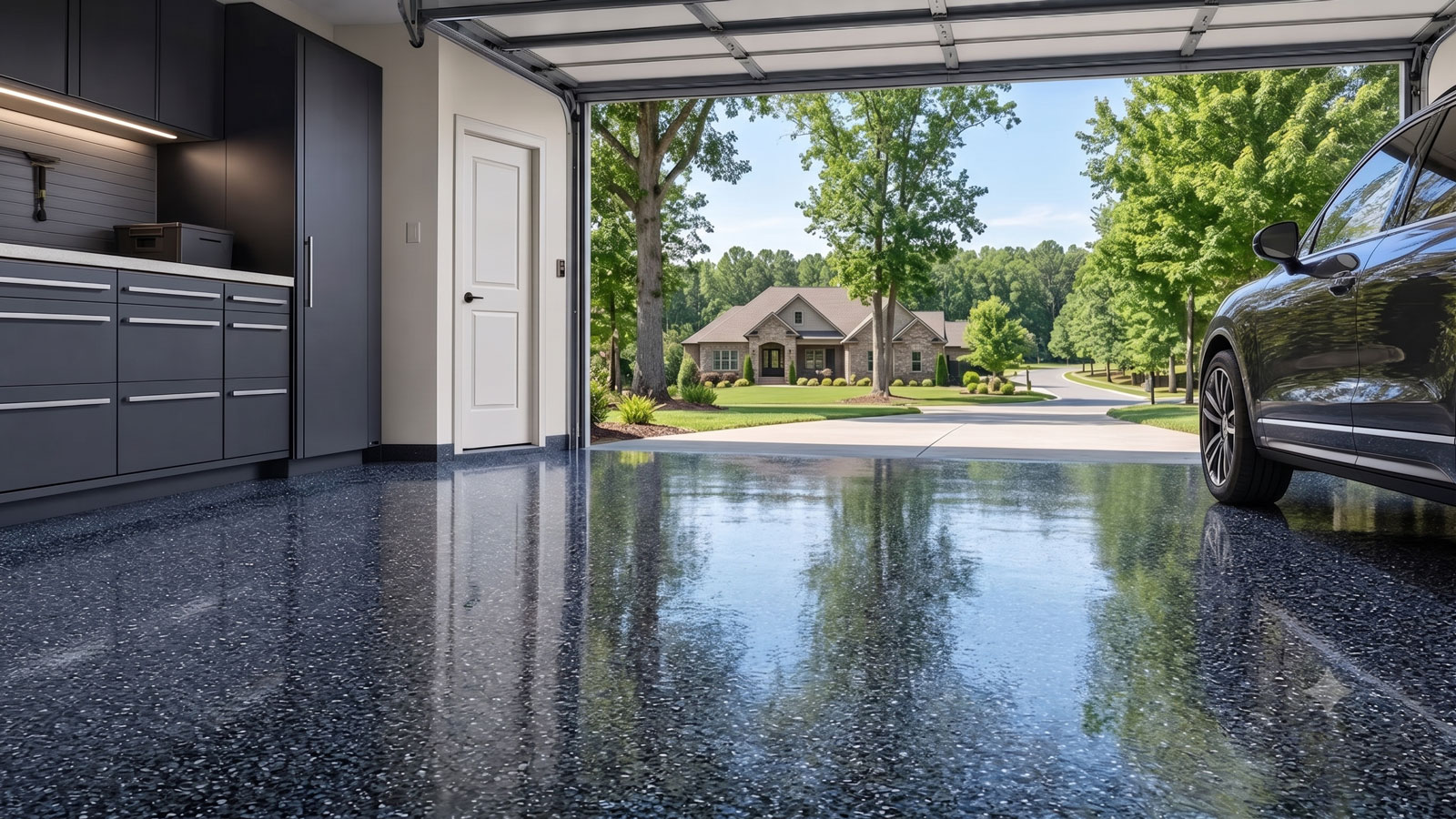
Garage Floor Coating in Winter Springs, FL
Floor Coating Services in Winter Springs, FL
Winter Springs occupies part of Seminole County's lake-and-drainage system, but its actual soil and runoff conditions vary by property. The county's floodplain-management profile reports 116 stormwater retention ponds in Winter Springs and identifies two broad, well-drained urban-land soil groups in local development contexts. Those documentary facts are useful local background; neither proves a particular garage slab is dry or ready for a resin coating without evaluation.
Seminole County's updated Howell Creek watershed study also includes portions of Winter Springs. The study's larger watershed boundaries explain why stormwater moves across municipal lines and why a low driveway threshold deserves attention after heavy rain. A coating cannot repair persistent outside runoff, so an estimate should separate garage-floor profiling, previous-paint removal, cracks, and any drainage project from one another.
Winter Springs households often need garages for parking, tools, and daily storage, and the practical exposure is hot tires, rainfall tracking, and sunshine at an open doorway. Look at the floor's actual coatings, repair history, and remaining usable space around built-ins. Product specifications, traction, cleaning habits, and the return-to-vehicle schedule should shape the bid; a generalized claim about Florida humidity is not enough to select a system.
Local Market Insight
Seminole County's floodplain-management documentation identifies 116 retention ponds in Winter Springs and describes well-drained local soil associations. Because the Howell Creek watershed also crosses the city, check actual property drainage and concrete evidence rather than inferring conditions from these regional maps.
What Affects the Cost of Garage Floor Coating in Winter Springs?
Winter Springs has a locally documented stormwater system: the county's floodplain-management profile identifies 116 retention ponds and notes well-drained soil associations in developed areas. Those facts describe broad soil and public drainage patterns, not the condition of an individual garage slab. A sound plan must still distinguish water tracked in by vehicles from a recurring low-threshold inflow or moisture within concrete.
The county's Howell Creek watershed update includes portions of Winter Springs and neighboring municipalities. That cross-city basin is one reason to look at the actual direction of surface water after summer storms. If a driveway continually funnels runoff beneath a garage door, fixing the outside water path should be evaluated before selecting an indoor coating.
Public pricing is $6-$12 per sq. ft.; a typical two-car garage is commonly $3,000-$5,500. The actual estimate depends on square footage, concrete condition, preparation, coating system, and finish choices.
- 116 city retention ponds: County planning documentation reports 116 retention ponds in Winter Springs. This is not a garage-level moisture reading, but it supports checking driveway grading and separating drainage correction from coating prep.
- Local soil association variability: The county profile names Urban Land–Tavares–Millhopper and Urban Land–Astatula–Apopka groups as generally well-drained. Soil association descriptions cannot confirm the vapor condition or construction quality of one concrete slab.
- Howell Creek regional drainage: The watershed management study encompasses parts of Winter Springs and nearby municipalities. Ask whether any repeated water entry is a real property-level issue before pricing a finish.
- Garage coating history: A painted, previously sealed or patched floor requires assessment of old layers. Specify coating removal and profiling on the actual surface instead of assuming every suburban concrete slab is the same.
- Movement joints and edges: Control joints, cracks, steps, threshold transitions and perimeter equipment add work. An estimate should identify repairs and leave joints treated in a way consistent with movement.
- Humidity and use schedule: Discuss installation weather, sun at the open door, and whether the garage handles daily vehicles or hobbies. Ask for product-specific cure conditions and return-to-parking instructions.
Call for a clear, project-specific estimate — or request one online.
Winter Springs' Soil Map Is Not a Slab-Moisture Test
The Seminole County floodplain profile names two main developed soil associations for Winter Springs, Urban Land–Tavares–Millhopper and Urban Land–Astatula–Apopka, and describes them as well drained. These are useful regional mapping facts, but they do not tell an owner how a finished garage slab was poured, sealed, patched, or exposed to water over its lifetime.
A property with a correctly graded driveway may stay dry at the door after rain, while another address within a generally well-drained soil association may experience recurrent runoff because of pavement pitch or a low threshold. Those situations call for distinct evaluations. Neither justifies an automatic assumption about moisture migration through concrete.
During a site visit, record old paint, oil staining, cracks, control joints, repairs and prior finishes. Ask whether the proposed preparation removes incompatible coatings and exposes sound concrete to the required profile. If conditions suggest persistent moisture, the installer should explain what evidence or tests justify any change in system.
The useful Winter Springs conclusion is restraint: regional soil and floodplain maps help shape questions, but proper slab diagnosis still happens at the garage. That keeps a coating project from becoming an unsupported waterproofing pitch.
Winter Springs Retention Ponds and Garage-Door Runoff
The county's floodplain-management documents report 116 stormwater retention ponds within Winter Springs, and the Howell Creek watershed study includes sections of the city. This network is a meaningful local drainage context, especially during the thunderstorms that shape Central Florida summers.
But ponds and watershed boundaries function at community scale. Water arriving with a parked car is normal wet-season housekeeping; water repeatedly crossing the driveway apron needs attention to the private property. A coating can make grit easier to clean when bonded well, but it cannot redirect water flowing in from outside.
Inspect the threshold just after rain: note where water accumulates, the condition of door seals, the apron slope, and any recurring stain or peeling line on the floor. Also check whether the garage has wall cabinets or stored items that will obstruct grinding along the perimeter.
For the coating itself, specify the system layers and UV rating near the door, traction appropriate for wet shoes, and realistic vehicle parking times. The correct solution depends on the existing concrete and observed water, not the number of retention ponds mapped elsewhere in Winter Springs.
Frequently Asked Questions
Are Winter Springs' mapped soils a guarantee that my garage concrete is dry?
No. County soil associations describe broad land conditions. Water exposure, slab construction, old sealers and past failures differ by property; a garage needs its own inspection.
What do the 116 Winter Springs retention ponds tell homeowners?
They show an established municipal drainage system. They do not test your slab or correct a poorly sloped driveway; recurring water at the garage threshold should be treated as a separate site concern.
Does the Howell Creek watershed imply I need a moisture barrier?
Not by itself. It is an area-scale hydrology study. Ask about specific evidence such as persistent dampness, old coating failures or a measured problem before adding moisture-related products.
What if my Winter Springs garage was painted years ago?
The installer should inspect adhesion and compatibility, remove unsuitable existing layers, profile the concrete and treat stable defects correctly before applying a new system.
Which coating offers easier rainy-season cleanup?
A correctly specified, well-bonded system can make cleanup easier; choose the surface texture, UV resistance and maintenance requirements around household use. A coating does not eliminate drainage work or all cleaning.
Winter Springs Neighborhoods & Local Context
Phone Quote Line
Talk through your garage, coating options, and project-specific pricing.
(689) 399-4111Typical Project Cost
$3,000-$5,500
Typical two-car garage range. Final pricing depends on floor size, concrete condition, prep work, coating type, and finish options.
Helpful Guides
Other Service Areas